A shift handoff drafted from notes nurses already write. Not yet tested on a ward.

A shift handoff drafted from notes nurses already write. Not yet tested on a ward.

A shift handoff drafted from notes nurses already write. Not yet tested on a ward.

Role

Research, IA, AI UX

Team

Team of three

Timeline

Aug to Dec 2024

Tools

Figma, Lovable, Miro

NurseShift · My Shift
NurseShift · Unit Board

At a glance

The short version, in thirty seconds

The move
The handoff is a by-product
Assembled from notes the nurse already wrote, so hour twelve brings no second writing task.
The system
Five roles, one record
Bedside nurse, charge nurse, manager, receptionist, administrator. All five prototyped.
The honest part
Design intent, not results
Built from published research and a tool benchmark. Nothing here is a measured outcome.

01 · Problem

Every twelve hours, a hospital rebuilds its memory. Anything left out, the next nurse starts the shift without.

Every twelve hours, a hospital rebuilds its memory. Anything left out, the next nurse starts the shift without.

Every twelve hours, a hospital rebuilds its memory. Anything left out, the next nurse starts the shift without.

A handoff moves responsibility for every patient on the unit, twice a day. Most still run on rushed conversation, paper notes or screens buried in the health record: the data is there, but nobody has turned it into a summary.

Outgoing nurse
Five ways a handoff fails
Incoming nurse
01
Information loss
Detail in one nurse’s head never reaches the next.
AHRQ · BMC Nursing
02
Inconsistent structure
Every nurse reports differently, so the receiver can’t tell what’s missing.
I‑PASS, NEJM
03
Poor prioritisation
The most urgent item competes with the most recent.
Workflow analysis
04
No accountability
Nothing records who received what, so gaps surface after harm.
The Joint Commission
05
Time pressure
Assembled at hour twelve, when capacity is lowest.
Nursing, 2022
0%
of serious medical errors involve miscommunication during handoffs
The Joint Commission
~0%
of hospital staff say important patient information gets lost at shift change
AHRQ Hospital Survey on Patient Safety Culture
0%
of nurses take 30 minutes or more to hand off four to six patients
Brown-Deveaux et al., Nursing, 2022
0 in 4
acute care nurses say important information is often missed at shift change
BMC Nursing, 2025
0%
fewer medical errors after structured I‑PASS handoffs, among resident physicians
Starmer et al., NEJM, 2014
Published figures on handoff communication. They describe the problem NurseShift was designed against, not results it produced.
The brief
How might we help nurses deliver complete, prioritised handoffs without adding documentation burden, while giving leadership the data it needs to improve safety?

02 · Research

Where the day breaks. We studied the tools and the twelve hours before drawing a screen.

Where the day breaks. We studied the tools and the twelve hours before drawing a screen.

Where the day breaks. We studied the tools and the twelve hours before drawing a screen.

What we set out to learn
Q1Where in a twelve-hour shift does the handoff break, and why then?
Q2What do existing tools already handle, and what do they still leave to the nurse?
Q3Who else touches the record at shift change, and what must each of them never see?
How
Literature review
Handoff research and structured protocols such as SBAR and I‑PASS.
Competitive benchmark
Nine capabilities across EHR-native handoff, clinical messaging and niche handoff apps.
Workflow analysis
A twelve-hour shift mapped hour by hour, load against the moment the handoff is due.
Secondary research only. No interviews or ward observation.
Competitive benchmark · 9 capabilities × 3 tool categories
EHR-native handoff
Epic, Cerner, MEDITECH
Clinical comms
Vocera, TigerConnect, PerfectServe
Niche handoff tools
NurseShift
Structured handoff sections
Five-section model
AI-generated handoff draft
AI draft, nurse review, verification needed
Closed-loop receipt
Viewed, with a name and time
Bedside Mode privacy filter
The clearest difference
Shift-based access windows
Explicit shift and prep time
Coverage requests with scoped access
Charge nurse board and overrides
Designed in
Completion, flags and severity analytics
Native
Audit trail for handoff actions
At the product level
AvailablePartialRareNot typicalThe gap
No category reliably drafts the narrative from the chart, closes the loop with a named receipt, or hides private notes at the bedside. NurseShift was designed around those three.
Compiled from vendor documentation and product material during the project. Capabilities vary by hospital build.
A twelve-hour shift
Illustrative
07:00
Handoff in
08:00
Assessments
10:00
Med pass
12:00
Rounds and orders
15:00
Care and events
18:00
Handoff out
Cognitive load
The handoff is written here
at the point of least remaining capacity
Shift startShift end
Time pressure, fatigue and competing priorities all peak at the hour the handoff is due. The load curve is illustrative, drawn from published research rather than measured on a ward.

03 · People

Four people, four different handoffs. Each role gets a screen built around what it must not see.

Four people, four different handoffs. Each role gets a screen built around what it must not see.

Four people, four different handoffs. Each role gets a screen built around what it must not see.

Composites from published nursing research and workflow analysis, not interviews. The administrator, the fifth role, is defined by permissions and the audit model.
“When my shift ends, I want the report to already exist, so I can check it instead of rebuilding it from memory.”
Their shift
Assessments, medications, charting and call lights, then a report for every patient.
What the handoff costs
Rebuilding each patient’s story from memory when capacity is lowest. 42% of nurses need 30+ minutes for four to six patients (Nursing, 2022).
Must never see
Patients outside their assignment.
What NurseShift gives
My Shift, a Tell Next Nurse tag on any note, and a drafted handoff to check instead of write.

04 · Insights

From research to decisions. Every decision answers a failure, plus the question of who sees what.

From research to decisions. Every decision answers a failure, plus the question of who sees what.

From research to decisions. Every decision answers a failure, plus the question of who sees what.

Failure
Design response
Where it’s answered
Information loss
A Tell Next Nurse tag on any note, and a draft assembled from those notes
Inconsistent structure
The same five sections in every handoff, for every patient
Time pressure
The handoff as a by-product of notes already written
Poor prioritisation
Severity on every card, doubtful items listed before the summary
No accountability
A named sign-off and a viewed receipt, both logged
Wrong people, wrong data
Five role scopes, each enforced by permissions

05 · Decision 01

Make the handoff a by-product of notes nurses already write. We weighed a separate form and dropped it.
Make the handoff a by-product of notes nurses already write. We weighed a separate form and dropped it.

Make the handoff a by-product of notes nurses already write. We weighed a separate form and dropped it.

A · Dropped
A separate handoff form
Chart all shift
Write it again at hour 12
Easy to build and explain, and familiar to nurses. It also adds a second writing task exactly where research said capacity runs out.
B · Shipped
Handoff as a by-product
1
Nurse writes a note
during care, as it happens
2
Tags it Tell Next Nurse
one tap, no extra writing
3
AI assembles a draft
structured into five sections
4
Nurse reviews and edits
corrects, adds, removes
5
Handoff confirmed
receipt tied to a name
One tag turns a routine note into a message for the next shift. Rejecting the form is the decision every screen after this one depends on.
In the build
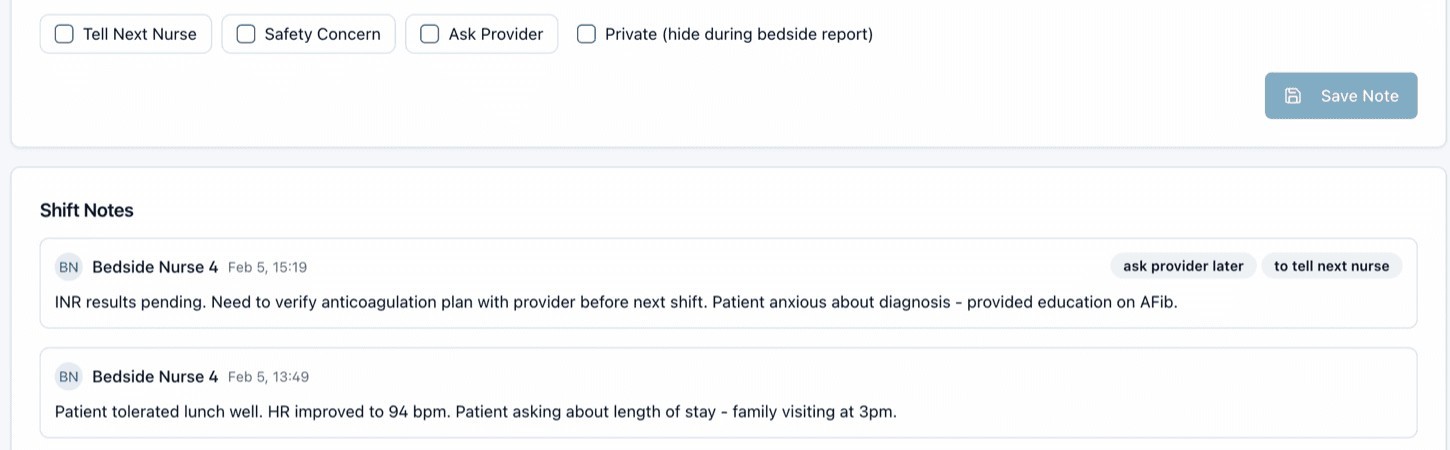
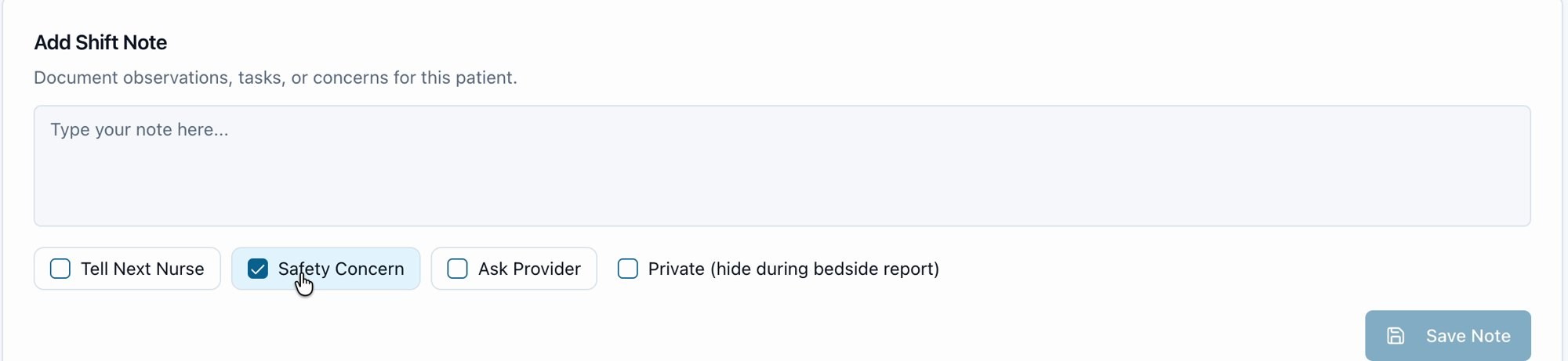
The tag sits on the note itself
Tell Next Nurse, Safety Concern and Ask Provider are options on the ordinary note form. Tagged notes carry their label in the shift log, ready for the draft.
NurseShift shift notes: Tell Next Nurse, Safety Concern, Ask Provider and Private options on the note form, above notes tagged to tell next nurse
Add shift note
Tell Next NurseSafety ConcernAsk ProviderPrivate
INR results pending…to tell next nurse
Tonight's draft
One tag while writing. Nothing is written twice at hour twelve.
One patient · day shift
07:00
11:00
15:00
19:00
07:49Admitted from ED, HR 142
tell next nurse
09:34Dizzy walking to the bathroom
safety concern
11:19Cardiology consult done
tell next nurse
13:49Lunch, HR 94
15:19INR results pending
tell next nurse
19:00 handoff
Draft handoff, ready to review
Built from the 3 notes tagged during the shift
Dropped: a blank form at 19:00, filled from memory
1
Incoming nurse reviews
the handoff, and confirms receipt
2
Documents through the shift
notes, vitals, labs, events
12 hours
One patient
twice a day
3
AI drafts the summary
before shift change
4
Outgoing nurse confirms
reviews, edits, signs off
What changes
Nothing is written twice
The note is the handoff source.
Prioritisation is structural
Four fixed sections, not free text.
Receipt is recorded
Confirmation is tied to a name and a time.
Leadership sees patterns
Without reading a single patient note.
The cycle, twice a day. Nothing in the loop asks the nurse to write the same thing twice.

06 · Decision 02

The model drafts, the nurse decides. Built for a setting where a wrong summary has consequences.

The model drafts, the nurse decides. Built for a setting where a wrong summary has consequences.
The model drafts, the nurse decides. Built for a setting where a wrong summary has consequences.

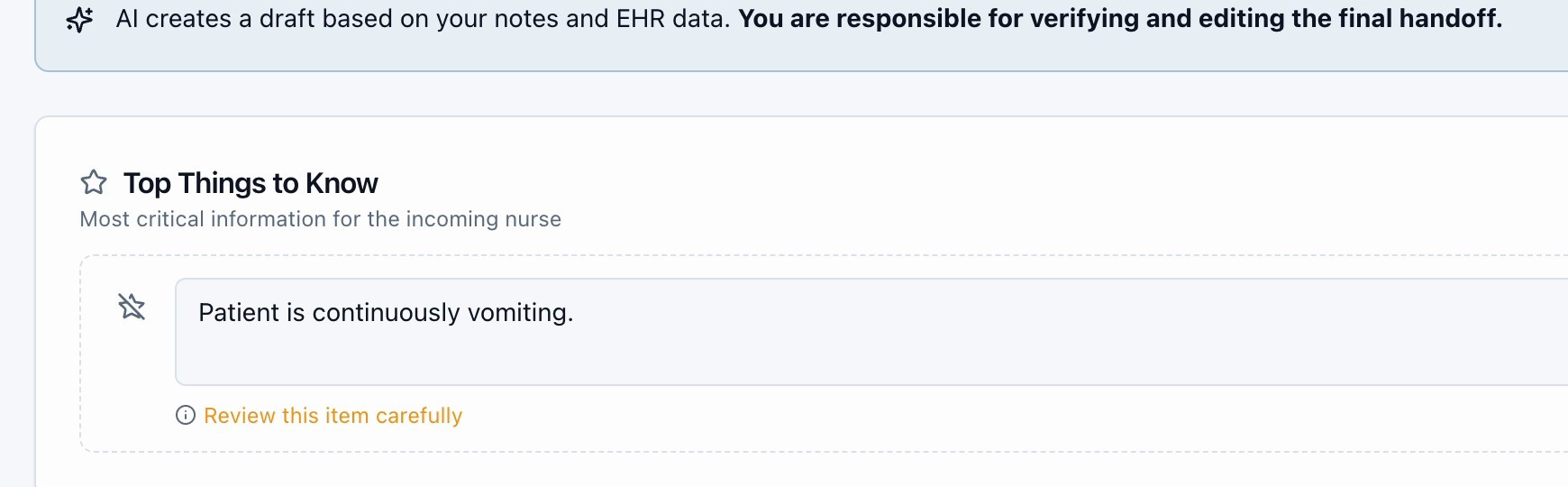
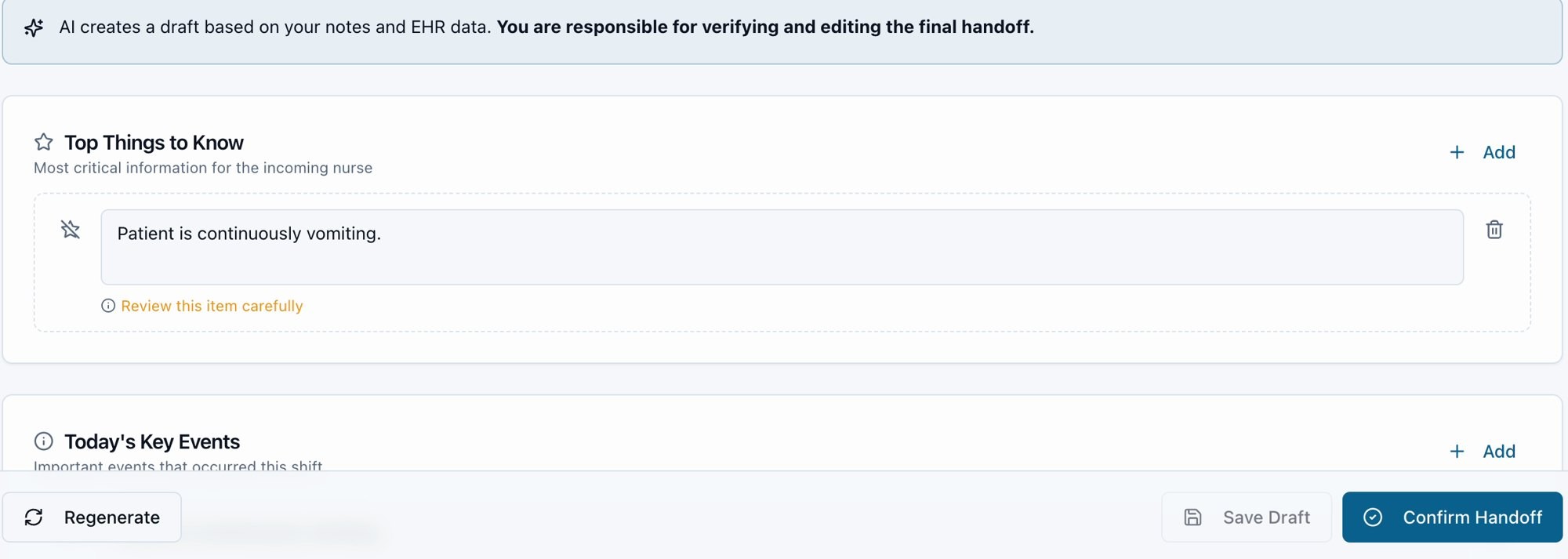
AI creates a draft based on your notes and EHR data. You are responsible for verifying and editing the final handoff.
Top Things to Know
Patient is continuously vomiting.
ⓘ Review this item carefully
Today's Key Events
Patient is continuously vomiting.
ⓘ Review this item carefully
RegenerateSave DraftConfirm Handoff
The reframe
Where can we use AI here?
Where do nurses carry the most fatigue? At end-of-shift handoff creation.
So the model’s job is a first draft and nothing more. A wrong summary has clinical consequences, and nurses have to trust the draft enough to check it properly.
In the build
The shipped draft screen
The responsibility banner sits above every draft, and lines the model is unsure of carry a Review this item carefully marker.
A NurseShift handoff draft: a banner reads AI creates a draft based on your notes and EHR data, you are responsible for verifying and editing the final handoff, above Top Things to Know items marked Review this item carefully,
Principle 01
Create a first draft, not a final answer
The model proposes. Every handoff leaves the screen only after a nurse has read it.
Principle 02
Surface uncertainty instead of hiding it
Where the source is thin, the draft says so rather than writing confident prose.
Principle 03
Preserve control and accountability
The confirming nurse owns the handoff. The banner on the screen says so in plain words.
Positioning the model as a drafting aid rather than an authority is what makes it adoptable where a wrong summary has consequences.

07 · Decision 03

One record, five scopes. Each role sees the least it needs.

One record, five scopes. Each role sees the least it needs.

One record, five scopes. Each role sees the least it needs.

Five roles touch the same patient record with different goals. One screen for all of them would have served none of them well.

Users, roles, auditUnit trendsUnit boardNotes, vitals, handoffAdmit and dischargeLimit
AdministratorNo clinical workflow
Nurse managerNo individual patient notes
Charge nurseAssigns care, does not chart
Bedside nurseAssigned patients only
ReceptionistNo notes or handoffs
One shared record. Each role opens one slice of it.
Who sees what · one patient record
Users, roles, audit
Unit trends
Unit board
Notes, vitals, handoff
Admit and discharge
Deliberately does not
Administrator
System
No clinical workflow, deliberately
Nurse manager
Unit over time
No individual patient detail
Charge nurse
Unit right now
Assigns care, does not document it
Bedside nurse
Patient
assigned only
Sees only assigned patients
Receptionist
Front desk
No access to clinical data
Administrator: Users, roles, shifts, patient assignment, audit log.
Nurse manager: Completion trends, severity mix, red-flag patterns.
Charge nurse: Every patient by nurse, support flags, handoff status.
Bedside nurse: Notes, vitals, flags, the handoff itself.
Receptionist: Admission and discharge only.
Permissions enforce each scope. A receptionist admitting a patient never sees a clinical note; a manager reading trends never sees an individual one.

08 · Interfaces

Five roles, five screens. Four recordings and one screen from the working prototype.

Five roles, five screens. Four recordings and one screen from the working prototype.

Five roles, five screens. Four recordings and one screen from the working prototype.

NurseShift · Bedside nurseRecording
Owns the patient
Bedside nurse
The screen a nurse lives in for twelve hours. Cards carry severity, flag count and handoff state.
Recording: My Shift, a patient’s notes and timeline, tagging a note, then editing and confirming the assembled handoff.

09 · Design system

A clinical interface should be boring on purpose. Nurses use it in glances between tasks, so four rules shaped it, and each gives something up.

A clinical interface should be boring on purpose. Nurses use it in glances between tasks, so four rules shaped it, and each gives something up.
A clinical interface should be boring on purpose. Nurses use it in glances between tasks, so four rules shaped it, and each gives something up.
Primary
#09698C
Primary tint
#E6F7FC
Surface
#F1F5F9
Secondary text
#64748B
Alert
#EF4444
Base
#FFFFFF
Confirm Handoff
Cardiology consult doneto tell next nurse
Fall RiskCritical
Teal carries actions and focus. Red is kept for high-risk flags only, so it always means danger.
Palette
Primary
#09698C
Actions, focus, the brand
Primary tint
#E6F7FC
Selected and informational states
Surface
#F1F5F9
Page and card grounds
Secondary text
#64748B
Labels and supporting copy
Alert
#EF4444
High-risk flags only
Base
#FFFFFF
Cards, sheets, inputs
AaAaAa
Rule 01
One typeface
Inter across the product, in three weights. A second face would cost recognition speed.
●Stable▲Watch Closely■High Risk
Rule 02
Status is never colour alone
Every state carries a word and a shape as well as a hue. Survives colour-vision deficiency and a bad monitor.
Rule 03
Density over whitespace
A whole patient fits in one glance. Whitespace is traded for fewer scrolls across a twelve-hour shift.
CancelDischarge patient
Rule 04
Destructive actions are slow
Discharging, reassigning or overriding takes a deliberate confirmation. A few extra seconds cost less than an irreversible mistake.
States and edge cases, from the working prototype
Severity and status: Colour, word and icon for every level: Stable, Watch Closely. Handoff status beside it: Draft or Complete.
Severity and status
Colour, word and icon for every level: Stable, Watch Closely. Handoff status beside it: Draft or Complete.
The draft, doubted: The responsibility line sits above the draft, a doubtful item says Review this item carefully, and Confirm is the only primary action.
The draft, doubted
The responsibility line sits above the draft, a doubtful item says Review this item carefully, and Confirm is the only primary action.
Bedside Mode: Private (hide during bedside report) keeps a note in the record but off the screen in front of the patient.
Bedside Mode
Private (hide during bedside report) keeps a note in the record but off the screen in front of the patient.
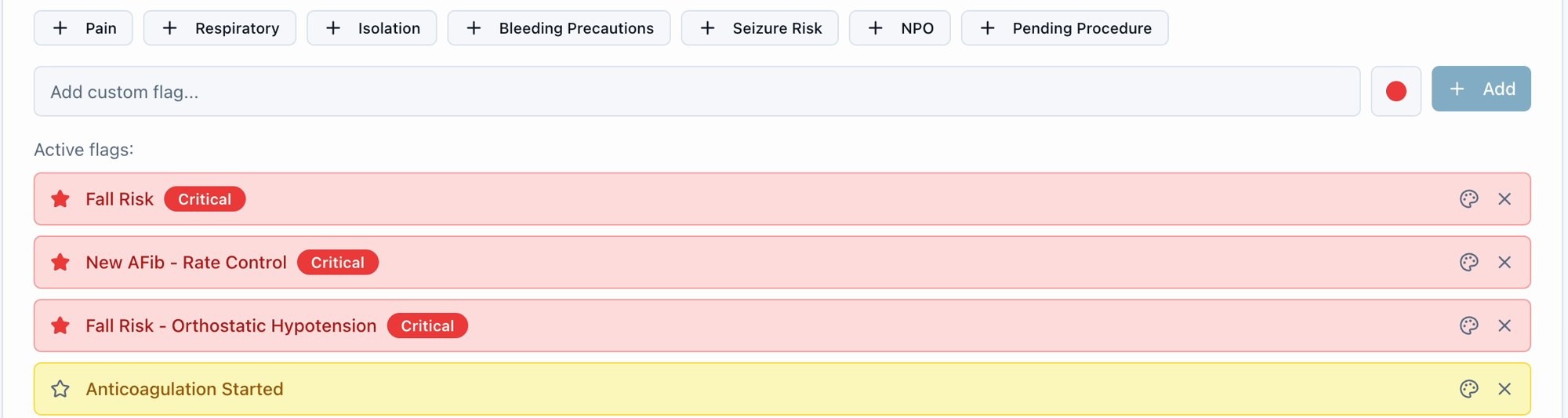
Critical flags: A starred flag is marked Critical and sits on red. Everything else stays yellow, so red keeps its meaning.
Critical flags
A starred flag is marked Critical and sits on red. Everything else stays yellow, so red keeps its meaning.
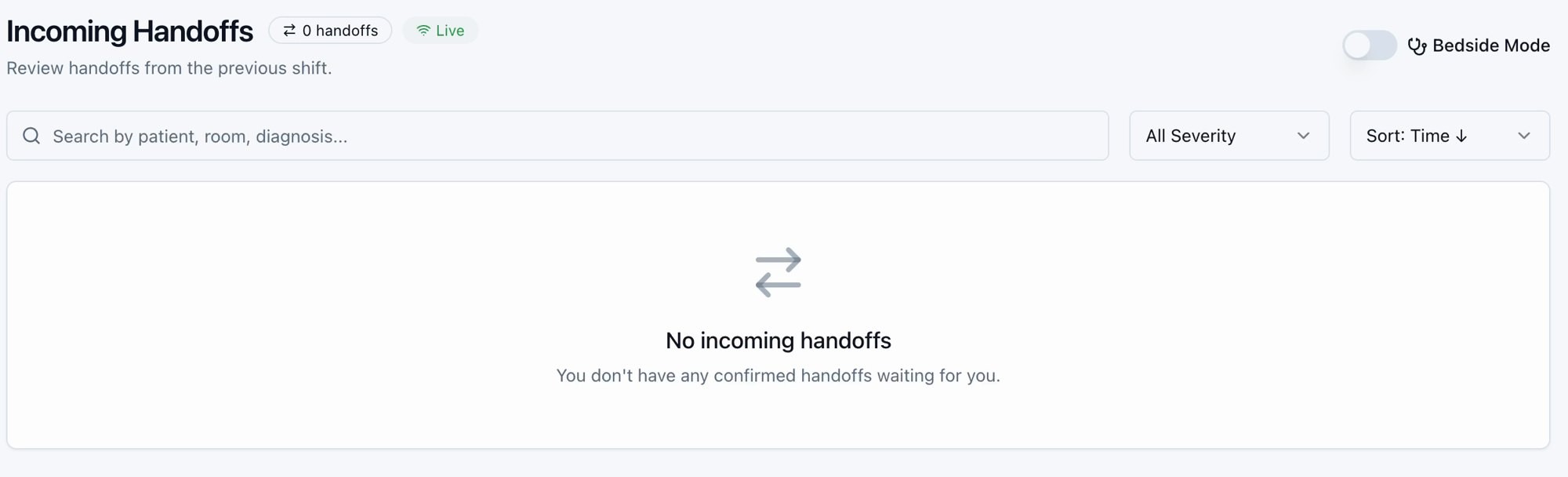
Empty state: No incoming handoffs. The empty state says what would appear here and why.
Empty state
No incoming handoffs. The empty state says what would appear here and why.
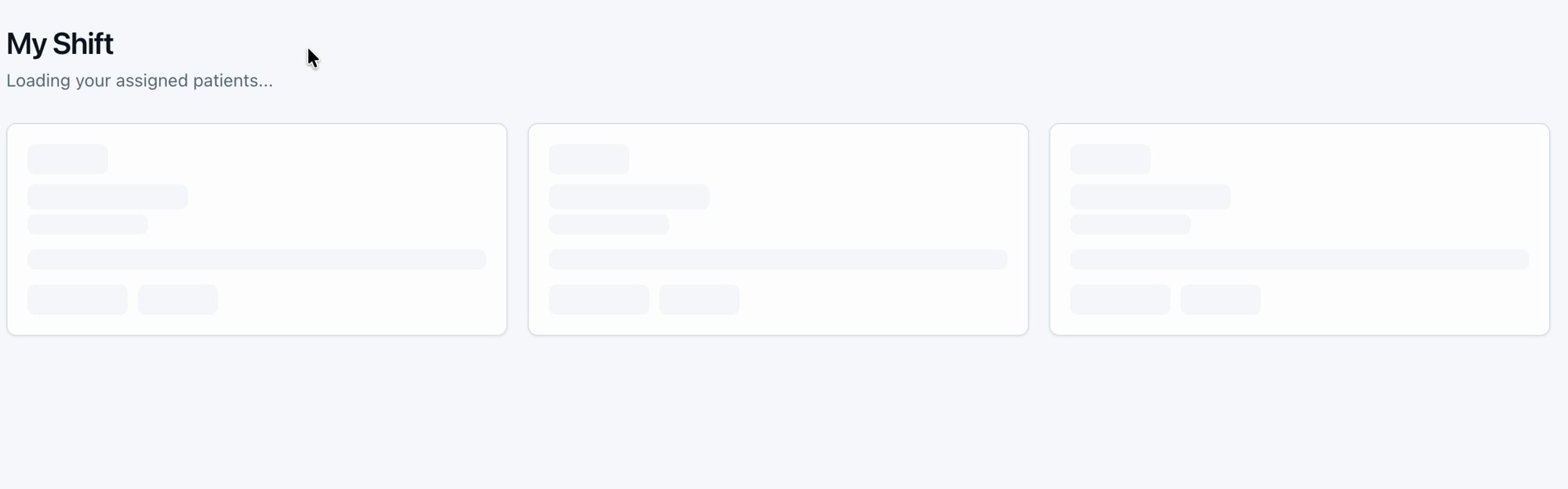
Loading: Skeleton cards hold the layout while patients load, so nothing jumps under the nurse’s hand.
Loading
Skeleton cards hold the layout while patients load, so nothing jumps under the nurse’s hand.

10 · Outcomes

What it was built to do. And what was never measured.

What it was built to do. And what was never measured.

What it was built to do. And what was never measured.

NurseShift was never installed on a ward, so there is no adoption curve and no measured change in handoff time. Everything below is design intent.

Design intent · not measured
Cut preparation time
The end-of-shift task becomes review rather than composition.
Design intent · not measured
Make completeness structural
Required sections and a live handoff state show a missing item before the shift ends, not after.
Design intent · not measured
Put a name on every transfer
Confirmed by a named nurse, marked viewed by the next one.
Design intent · not measured
Give leadership trends without patient notes
Completion trends and recurring red flags are enough to act on.
Aug 2024
Dec 2024
Research
Design
Prototype
Five roles designed
all five prototyped as working screens
A working prototype
recordings and screens, section 08
A measurement plan
written, never run
The semester ends here
Two quarters on
Baseline
Adoption
Tracking
Time on taskNo data yet
preparation timed before and after adoption
Handoff completenessNo data yet
scored against an I‑PASS rubric, by someone other than the designer
Error and near-miss ratesNo data yet
tracked over at least two quarters, against a baseline
Each measurement needs a baseline, an adoption period and two quarters of tracking. The semester ended before the first could start, and saying so is more useful than a number I can’t stand behind.
How I’d test it first
Method
A moderated usability test, then a two-week pilot on one unit.
Participants
Five to eight bedside nurses and two charge nurses from one medical-surgical unit.
Tasks
Tag a note for the next nurse during care. Review tonight’s draft and clear its flags. Confirm a handoff, then receive one.
Measured by
Time to confirm, edits per draft, items missed against an I‑PASS checklist, and a SUS score.

11 · Reflection

Removing doubt beats adding features. The version worth building took the most doubt out of the riskiest ten minutes of a nurse’s day.

Removing doubt beats adding features. The version worth building took the most doubt out of the riskiest ten minutes of a nurse’s day.

Removing doubt beats adding features. The version worth building took the most doubt out of the riskiest ten minutes of a nurse’s day.

What worked
Refusing the separate form
The decision that looks smallest is the one I’d defend hardest. Leaving out the feature every tool ships made the rest worth building.
The limitation
No time on a ward
Five conversations with working nurses would have tested the role boundaries harder than any amount of secondary reading.
Next time
Test before drawing
Moderated testing with practising nurses, an EHR integration path so the record is read rather than retyped, and a measurement plan agreed with a unit first.
What this case rests on
USED
Published clinical research
every figure on this page is sourced to it
USED
Competitive benchmark
EHR, clinical comms and niche handoff tools, capability by capability
USED
Workflow analysis
where a handoff breaks, mapped from the literature
NOT DONE
Time on a ward
none
NOT DONE
Conversations with practising nurses
none, and the first thing I would change
Three sources carried this project. The two hollow ones are the ones we never used.